
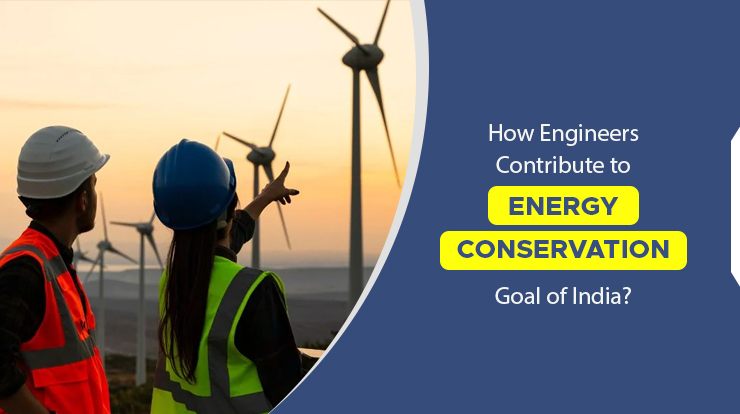
Engineers cut national energy waste by designing efficient systems, auditing and optimising assets, and deploying digital control that turns saved kilowatt-hours into lower bills, higher productivity, and cleaner air at home, campus, factory, grid, and city scale. This is the daily work of an energy conservation engineer, delivered through rigorous energy systems engineering.
At Sangam University, experts guide you to find and fix energy waste, run projects, and prove savings so you graduate as an energy conservation engineer from a leading Btech college in Bhilwara.
Continue reading below for simple steps, real examples, and how Sangam University supports you in energy systems engineering.
How Engineers Support India’s Energy Conservation
Use this quick checklist to see how an energy conservation engineer applies energy systems to cut India’s energy use:
-
Measure first: Record where electricity and fuel are used, and for how long.
-
Find waste: Do simple walk-through checks to spot leaks, idle loads, and poor settings.
-
Fix and keep it fixed: Set clear routines and checklists so savings don’t slip back.
-
Track progress: Set targets, watch key numbers, and review a simple monthly dashboard.
-
Prove the saving: Compare meter data and bills before and after each change.
-
Design smart: Choose equipment and materials that use less energy over their whole life.
-
Count the emissions: Add up pollution from on-site fuel, purchased power, and suppliers.
-
Plan the journey: Prioritise quick wins, map costs and payback, and set dates for each step.
-
Follow the rules: Match national codes and schemes, and use available incentives.
-
Share and train: Teach teams, assign owners for each action, and celebrate wins.
Energy Systems Engineering: Tools That Make a Big Difference
Use this plain list of meters, software, and kits an energy conservation engineer relies on to measure, fix, and prove savings:
Measure & log
-
Smart meters and sub-meters: Track use area-wise for an energy audit.
-
Clamp meter: Check motor current safely.
-
Power quality analyser: Spot voltage and power factor issues.
-
Data loggers: Record kWh, temperature, flow, and hours.
-
Thermal camera/IR thermometer: Find hot spots and poor insulation.
-
Ultrasonic leak detector: Locate hidden compressed-air leaks.
-
Airflow hood/anemometer: Measure fan and HVAC airflow.
-
Flue-gas analyser: Tune boilers for clean, efficient burn.
Control & retrofit
-
Variable frequency drive (VFD): Slow motors when load is light.
-
High-efficiency motors (IE3/IE4): Same work with less power.
-
Timers and occupancy sensors: Switch off when not needed.
-
LED retrofit kits: Cut lighting power fast.
-
Heat-recovery units: Reuse waste heat from exhaust.
-
Power factor correction panels: Reduce reactive losses.
-
Insulation jackets and sealing kits: Stop heat and air leaks.
Digital & dashboards
-
Building Management System (BMS): One screen to manage HVAC and lights.
-
SCADA monitoring: Watch live plant data and alarms.
-
IoT sensors for energy: Add meters where none exist.
-
Simple M&V sheets: Compare before/after savings clearly.
Software
-
Pump and fan curve tools: Set efficient operating points.
-
Building energy modelling: Test building changes before you spend.
-
Load-forecast and peak trackers: Plan peak shaving and demand response.
-
Energy benchmarking dashboards: See progress at a glance.
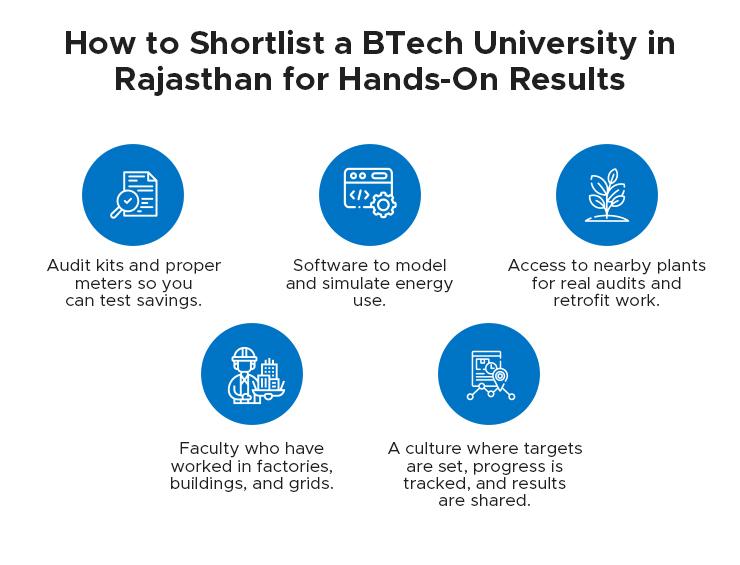
At Sangam University, the leading Btech college in Rajasthan, students use these tools on live campus systems and turn findings into clear, before-and-after energy savings.
Grid, Digitalisation and Flexibility
Engineers also help by improving how electricity is produced, moved, and used.
-
Smart grid & load forecasting: Smarter planning prevents waste and blackouts.
-
Peak shaving & demand response: Shift use to off-peak times to cut bills.
-
Microgrids & VPPs: Local grids and pooled resources keep power reliable.
-
Battery energy storage systems (BESS): Store cheap power, use it when demand is high.
-
Renewables & HVDC lines: Move solar and wind across long distances with fewer losses.
-
Better quality power: Use feeder changes, voltage control, and inverter upgrades to reduce losses.
-
Cleaner transport: EV charging infrastructure, regenerative braking, and smart design make travel energy-friendly.
Buildings and Campuses
On campus and in homes, small design choices save a lot of energy.
-
Building energy modelling & EUI: Plan before building, and track energy per square metre.
-
Retro-commissioning: Reset systems to run as they were meant to.
-
Passive solar & daylighting: Use sun and light naturally to cut costs.
-
Net-zero energy buildings: Aim to make as much energy as you use.
-
Green ratings & codes: Meet LEED, GRIHA, and ECBC India standards.
-
Solar water heating: Warm water with the sun.
-
Thermal storage & PCM: Store coolness/heat for peak times.
-
District cooling/heating: Share one system across many buildings for efficiency.
Campus as a Living Lab: Why a BTech College in Bhilwara Can Lead
Bhilwara is surrounded by industries. This gives students real access to factories, data, and experts.
-
On campus, students try small energy audits, solar rooftops, and storage projects.
-
Hostels and labs become practice grounds for demand-side management using power wisely.
-
Bills are studied to learn time-of-use pricing and how shifting usage saves money.
-
Students join local energy groups and test simple behaviour changes, like switching off lights earlier.
-
Teachers connect the campus with companies through joint projects.
-
Teams learn how to pool demand for funding and bigger upgrades.
-
Classes also explain India’s key energy policies like Energy Conservation Act, PAT scheme, BEE Star Labels, National Solar Mission, UJALA LED programme, FAME India for electric vehicles, and Renewable Purchase Obligations.
As one of the best colleges for BTech in Rajasthan, at Sangam University, these live projects turn classrooms into real training grounds for future energy conservation engineers.
From Classroom to Careers: How to Choose a BTech College in Rajasthan for Real Impact
When you select a college, look for signs that students practise what they learn.
-
Check if labs feel like real industry workshops.
-
Ask if workshops have their own meters, live dashboards, or rooftop solar data.
-
Seek teachers who guide projects that solve real problems, not just theory.
-
A BTech college in Rajasthan with industry tie-ups can turn these projects into internships and job offers.
-
This is how a future energy conservation engineer becomes job-ready.
Final Words
Engineers help the country save energy by checking where power is wasted, fixing it, and proving the results. An energy conservation engineer creates the most impact when campus, industry, and policy all work together.
At Sangam University our focus is on creating energy conservation engineers who understand both the classroom and the field where campus projects, industry exposure, and national policy come together. As a leading BTech university in Rajasthan, we give students the skills, tools, and guidance to build projects that matter and measure the savings with confidence.
Join Sangam University and become the energy conservation engineer who helps India save power, reduce costs, and build a cleaner future.
FAQ
Q1. What skills do I need to become an energy conservation engineer?
Ans. You need problem-solving, basic maths, an eye for waste, and the ability to use tools like meters, sensors, and simple modelling software.
Q2. What is the salary and job growth for energy conservation engineers in India?
Ans. Freshers usually earn ₹3-6 LPA, with growth as energy laws, green buildings, and clean-tech projects expand across India.
Q3. Which engineering branch is best for energy conservation work?
Ans. Mechanical, Electrical, Civil, and Chemical are most common, but Computer Science is rising with smart grid and IoT.
Q4. How long does it take to see real energy savings in a project?
Ans. Simple fixes like LED retrofits or leak repairs show results in weeks, while bigger upgrades may take 6-18 months.
Q5. Are energy conservation jobs available outside industry, like in government or NGOs?
Ans. Yes. Many roles like Energy auditor or manager, Programme officer exist in government agencies, energy efficiency consultancies, NGOs, and sustainability programmes.


