

Many management students graduate with strong theoretical knowledge, yet employers often find them lacking in real-world business skills and practical exposure. This gap makes internships a crucial part of every MBA journey.
Internships help management students connect classroom learning with real business situations, develop leadership and teamwork, and improve employability. In short, they prepare students for career success.
At Sangam University, internships are seen as the start of your career journey, not just a requirement. As the top MBA college in Bhilwara, we connect students with real companies, experienced mentors, and live projects. This hands-on exposure helps you build confidence, sharpen skills, and open doors to strong placement opportunities.
Keep reading to understand the full role of internships in business management and how they shape your career.
3 Benefits of an Internship for Management Students
For MBA students, an internship isn’t just a checkbox in the curriculum, it’s where you test what you have learned and discover how business works in real time. Here’s why it matters most from a student’s point of view:
#1 – Industry Exposure and Real-World Application
Internships bring business management alive. Students handle client meetings, research projects, and strategy planning. This internship experience for management students builds a practical understanding that books alone cannot offer.
#2 – Skills That Shape Future Leaders
During internships, MBA students develop:
- Communication skills from internships through presentations and client interaction.
- Teamwork skills in MBA internships while working on group projects.
- Leadership development during an internship by handling responsibilities.
- Analytical skills from business projects through case studies and data analysis.
- Time management by balancing deadlines and deliverables.
#3 – Career Outcomes and Placement Success
Internships are often the first step toward a career:
- Companies extend pre-placement offers (PPOs) to top performers.
- Students improve their resumes by adding internship outcomes for management graduates.
- They gain employability through internships, increasing placement opportunities.
- Even an unpaid internship for experience boosts a fresher’s hiring chances.
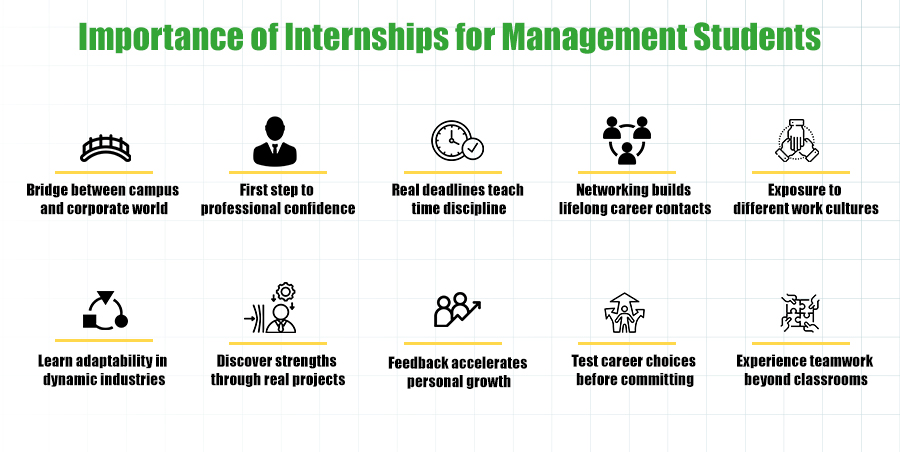
How Internships Fit Into Your MBA Curriculum?
Internships are not separate from your MBA learning; they are integrated into your academic journey at Sangam University, the best MBA college in Bhilwara.
- Internship credits in MBA ensure your experience counts toward graduation.
- You prepare internship reports and presentations that are evaluated as part of coursework.
- Faculty mentoring during internship guides you in setting objectives and achieving them.
- Evaluation parameters and rubrics help assess your learning outcomes.
This structure for internship experience for management students ensures that every student’s internship is meaningful, guided, and adds direct value to their academic progress.
Internship Opportunities Across Management Domains
Students pursuing an MBA can explore internships across diverse domains, each offering unique skills and career pathways that shape their specialisation and future roles.
- Marketing Internship MBA → digital marketing, brand research, market entry studies.
- Finance Internship MBA → portfolio analysis, risk assessment, auditing.
- HR Internship MBA → recruitment drives, employee engagement projects.
- Operations Internship MBA → supply chain optimisation, process mapping.
- Business Analytics Internship → predictive models, dashboards, insights.
- Sales Internship for Management Students → lead generation, customer handling.
- Product Management Internship → product lifecycle, launch strategy.
- Entrepreneurship Internship → startup business plans, fundraising.
- International Business Internship → global trade projects, export strategies.
- Consulting Internship for MBA → strategy assignments, business transformation.
- Hospitality or Healthcare Management Internship → service operations, hospital administration, healthcare projects.

How to Find and Succeed in MBA Internships?
At Sangam University, one of the best MBA colleges in Rajasthan, students don’t have to struggle alone to secure internships. Our dedicated internship cell works with leading companies, alumni, and industry partners to ensure every student gets meaningful opportunities. Once placed, it’s up to the student to prepare well and make the most of the experience.
Finding the Right Internship
- Rely on the internship cell at Sangam University for structured opportunities.
- Benefit from companies visiting Sangam University for campus recruitment and projects.
- Leverage alumni referrals and industry tie-ups that the university has built over time.
Preparing Applications
- Work with faculty and placement mentors to draft a strong cover letter for an MBA internship.
- Build a polished resume format for an MBA internship with university guidance.
- Practice interview questions for an internship with mock sessions organised on campus.
Maximising Internship Value
- Focus on industry networking during internships to build long-term contacts.
- Leverage mentorship in internships to gain practical knowledge.
- Strengthen your LinkedIn profile for MBA interns by showcasing projects.
- Use feedback and performance reviews to continuously improve.
- Aim at converting the internship to PPO by showing initiative and ownership.
Build a portfolio from projects and request references from internship supervisors to boost employability.
Conclusion
Internships are the bridge between classroom learning and career success. They develop critical skills, provide industry exposure, and improve employability.
At Sangam University, every student is prepared for a successful career with meaningful internships and strong placement support. If you’re looking for the best MBA college in Rajasthan that blends academics with industry learning, Sangam is your destination.
Explore MBA programs at Sangam University Bhilwara today and build your future with confidence.
FAQ’s
When do MBA internships usually take place, and how long do they last?
Ans. Most MBA internships are scheduled in the summer between the first and second year of study, and they usually last 8-12 weeks.
What types of companies typically hire MBA interns?
Ans. Consulting firms, banks, FMCG companies, IT firms, e-commerce players, startups, and manufacturing companies actively recruit MBA interns across domains.
How can students find internship opportunities beyond standard job portals?
Ans. In addition to online job portals, you can use alumni networks, university internship cells, career fairs, and direct company applications.
Is the MBA internship a pathway to full-time jobs?
Ans. Yes, many internships act as a trial period for companies. Strong performers often receive pre-placement offers or full-time job opportunities.
Does internship duration differ by format or industry?
Ans. Yes. While summer internships are usually 2-3 months, consulting projects, virtual internships, and startup roles may be shorter or flexible in duration.
Are internships unpaid or paid, and what should students expect?
Ans. Most MBA internships are paid, especially with large companies. Smaller firms and startups may offer unpaid internships, but provide valuable learning and exposure.
