
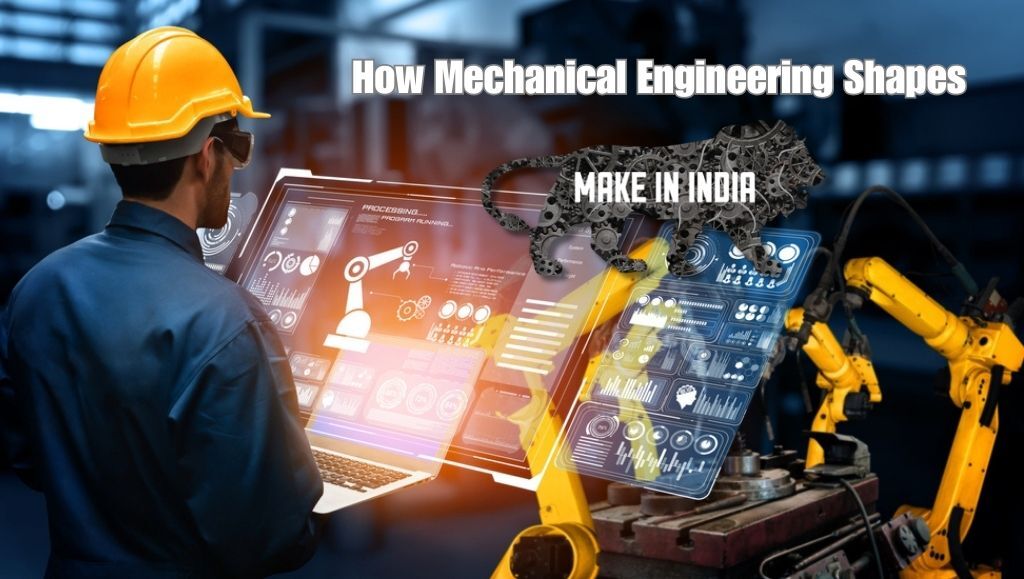
India is entering an exciting phase of growth with its Make in India initiative, a campaign that encourages industries to innovate, manufacture locally, and boost exports. At the heart of this progress is mechanical engineering, a branch that builds machines, powers factories, and drives industrial change. As the mechanical industry in India grows, so does the need for skilled engineers who can combine technical knowledge with practical solutions.
At Sangam University, we prepare the next generation of engineers to play an active role in this transformation. Recognised among the best colleges for engineering in Rajasthan we offer a BTech programme designed to equip students with both academic depth and industry-ready skills. Students learn not just theory but also the practical skills needed to contribute to national missions like Make in India.
In the next sections, our expert will walk you, as a prospective mechanical engineering student, through –
-
Mechanical Engineering & Make in India,
-
Key Duties & Responsibilities,
-
Graduate Success Stories,
-
Admission Pathway with BTech.
Let’s explore how you can turn your engineering education into a platform for nation-building and personal success.
How Mechanical Engineering is Shaping the Make in India Initiative
Mechanical engineering is the backbone of manufacturing. Every product you see like cars, trains, turbines, or even renewable energy systems depends on mechanical engineers. In the context of Make in India, their role becomes even more crucial.
-
Automotive and transport: Engineers design and produce vehicles for domestic and export markets.
-
Defence and heavy machinery: Local production reduces dependence on imports.
-
Renewable energy and robotics: Innovation in solar, wind, and automation makes India globally competitive.
By driving these sectors, the mechanical industry in India contributes directly to reducing imports, boosting exports, and creating millions of jobs. Without skilled engineers, Make in India would remain just an idea, not a movement.

Core Duties & Responsibilities of Mechanical Engineers
So, what do mechanical engineers actually do? The mechanical engineering duties and responsibilities include:
-
Designing and testing new machines and systems.
-
Planning production to improve speed and efficiency.
-
Carrying out quality checks to ensure safety and reliability.
-
Maintaining equipment and ensuring smooth operations.
-
Working in research and development to bring new ideas to life.
-
Applying industrial automation and robotics to modernise factories.
Each of these responsibilities translates directly into Make in India’s goals of producing world-class products, scaling up manufacturing, and ensuring innovation happens within the country.
Mechanical Engineering at Sangam University – Powering Make in India in 2025
At Sangam University, a top engineering college in Rajasthan, our BTech Mechanical Engineering programme is designed to prepare students for leadership in the mechanical industry in India.
We integrate practical skills, industry projects, and a Make in India mindset into our AICTE-approved curriculum. You learn the science of machines and the logic of manufacturing in the same classroom, then prove both in real projects and internships.
-
Degree & Structure: BTech (4-year, full-time) with a core focus on Mechanical Engineering, supported by electives in automation, energy systems, and industrial design.
-
Study Mode & Duration: Full-time undergraduate programme, structured across 8 semesters. Ideal for students after 12th who want to step directly into engineering careers.
-
Core Mechanical Modules: Design of Machines, Thermodynamics, Fluid Mechanics, Production Technology, Robotics, and Renewable Energy Systems, all aligned with the Make in India initiative.
-
Experiential Learning: Industry internships, capstone projects, and workshops in CNC machining, CAD/CAM, and automation ensure you graduate with portfolio work, not just classroom notes.
-
Admission Path: Merit-based admission for BTech. Students with strong scores in JEE or equivalent exams are prioritised. Sangam University also offers guidance and counselling for smooth admission.
-
Accreditation & ROI: AICTE-approved degree with affordable tuition compared to metros. Graduates secure placements in automotive, energy, and manufacturing industries, delivering strong returns on investment.
-
Campus Advantage: Located in Bhilwara, Rajasthan, we have modern labs, workshops, and a peaceful environment for focused study, ideal for anyone searching for a top engineering college in Rajasthan with industry-ready exposure.
Apply Now for BTech Mechanical Engineering at Sangam University
Seats for the 2025 batch are limited and fill quickly after board results are announced. Secure your admission at the leading Btech college in Rajasthan and take the first step towards a career that aligns with the Make in India initiative.
Call our admissions desk: +91-7891050000/05
Email: admissions@sangamuniversity.ac.in (responses within 24 hours)
Campus visit: Sangam University – NH-79, Bhilwara Chittor Bypass, Bhilwara, Rajasthan, India, easily accessible for anyone searching for a top engineering college in Rajasthan.
Next step: Apply online through the university portal, submit your academic documents, and connect with our team for counselling, fee details, and scholarship options.
Start your journey with Sangam University today and graduate as a skilled engineer ready to power the mechanical industry in India.
FAQs
Q1. What is the scope of mechanical engineering in India after 2025?
Ans. Mechanical engineering has wide scope in India, especially with the Make in India initiative boosting manufacturing, defence, and renewable energy. Engineers are in demand across industries like automotive, robotics, and infrastructure.
Q2. Which industries hire mechanical engineers under Make in India?
Ans. Key industries include automotive, defence equipment, heavy machinery, renewable energy, and robotics. These sectors rely on mechanical engineers to design, produce, and improve systems for both local and export markets.
Q3. Is Rajasthan a good place to study mechanical engineering?
Ans. Yes, Rajasthan is becoming a hub for engineering education, with several top engineering colleges in Rajasthan. Sangam University, Bhilwara, offers industry-focused training that connects students directly to the mechanical industry in India.
Q4. What salary can a mechanical engineer expect in India?
Ans. Fresh graduates usually start with ₹3-5 LPA, depending on skills and the company. With experience in automation, robotics, or renewable energy, salaries can rise to ₹8-12 LPA or more.
Q5. What skills should I develop to succeed as a mechanical engineer?
Ans. Along with core subjects like design and thermodynamics, focus on CAD/CAM, industrial automation, robotics, and renewable energy systems. These skills make you more employable in the era of Make in India.

