

The right college is the one that aligns with your goals, proves its quality with outcomes and fits your budget and lifestyle. It shapes not only your learning but also your friendships and the career path you step into. But with so many options, it’s easy to feel stuck, rankings, fees, placements and promises all start to blur.
At Sangam University we solve this decision gap with NAAC recognition, 125+ programmes across diverse fields, strong internships and placement networks, transparent fees and a safe, modern campus in Bhilwara. These pillars make Sangam a consistent and leading choice for students looking for the best university in Rajasthan.
Keep reading to explore the expert approved top tips for selecting a college, a practical college decision guide designed to help you make the right decision with clarity and confidence.
Top 10 Tips for Choosing a College That’s Right for You
The toughest part of choosing a college isn’t the options, it’s knowing which choice will shape the life you want. Here’s how to choose a college according to your requirements:
1) Start With You: Goals, Priorities and Fit
The right choice depends on your goals, priorities and the path you want to take in life. A simple college decision guide can help you define what matters most.
Ask yourself:
- What career am I interested in? (Choosing a career path)
- Which degree program excites me? (Selecting a degree program)
- Do I want flexibility to explore or a fixed track?
- What are my personal priorities, location, placements or cost?
This step ensures you don’t get distracted by names and rankings but instead focus on the best college for you.
2) Trust Signals First: Approvals, Faculty, Reputation
Quality matters more than claims. Before shortlisting, confirm that the college proves its worth.
Check for:
- Accreditation status like UGC, AICTE or NAAC recognition.
- Faculty quality, their experience and research.
- Overall academic reputation of the college.
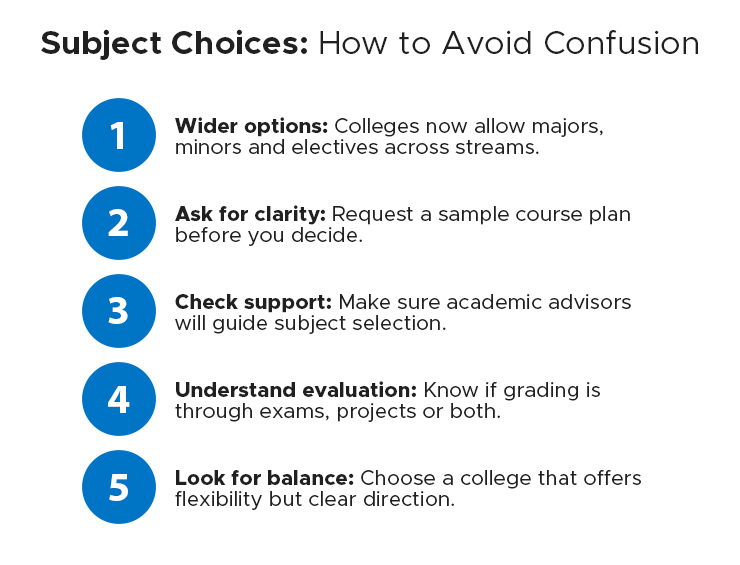
- Options for honors programs, elective choices and interdisciplinary courses for curriculum flexibility.
- Subject-specific program ranking if available.
3) Academics That Work for You: Structure and Support
A college is only as good as its academics. Look beyond course names and see how they are delivered.
Key questions:
- Does it offer the course availability you want?
- Are there strong majors and minors?
- What is the teaching methodology, traditional or interactive?
- Is academic advising available when you are confused?
- Are there proper academic support services like remedial classes?
- Can you access library resources, lab facilities and research opportunities?
- Does the course structure include internships and placements?
These details will help you find the right college academically.
4) Location & Lifestyle: Comfort, Safety and Access
The college location decides how you live day-to-day. Don’t ignore lifestyle factors.
Think about:
- What type of campus would you prefer?
- What’s the distance from home and transportation access?
- Is there strong safety on campus?
- Does the cultural environment and student diversity suit you?
Your lifestyle and comfort affect your focus as much as academics.
5) Money Matters: Check Real Cost, Not the Sticker
Calculate carefully to avoid surprises later
Include in your budget:
- Tuition fees for your programme.
- Any scholarships and grants or financial aid packages offered.
- Availability of student loans and merit scholarships.
- Extra chances like work-study programs or part-time jobs on campus.
- Daily cost of living, hostel, food, travel.
- The long-term return on investment after placements.
This is how to choose the right college India relies on without being misled by the sticker price.
6) Placements & Careers: Outcomes Over Promises
Colleges often promise placements but you need evidence.
Verify:
- Past campus recruitment numbers and job placement rates.
- Strength of the alumni network.
- Access to career counseling and skill development programs.
- Real internships with industry during study.
- Opportunities for professional networking and global opportunities.
- Support for entrepreneurship or graduate school preparation.
This ensures your right college decision is backed by real career outcomes.
7) Campus Life: Where You Will Actually Live and Grow
Your college years are also about community and growth outside classrooms.
Look into:
- Quality of student housing, dormitories and hostels.
- Dining options available on campus.
- Clubs, extracurricular activities and sports facilities.
- Vibrant campus clubs and student organizations.
- Access to arts and culture events and community engagement.
- Wellness support through wellness programs.
Good campus life builds confidence, friendships and leadership skills.
8) Tech & Facilities: Learn With Modern Tools
Modern learning needs modern spaces and technology.
Check for:
- Smart classrooms and digital teaching tools.
- A strong digital library and IT infrastructure.
- Latest lab equipment and advanced research centers.
- An active innovation hub for projects.
- Access to e-learning platforms and a Wi-Fi enabled campus.
- Add-ons like virtual internships and online career portals.
This shows how future-ready the college is.
9) Scale, Selectivity and Support
The size and selectivity of a college affect your day-to-day experience.
Evaluate:
- Campus size and student population, do you want big and lively or small and focused?
- Admission requirements and acceptance rates, is it very selective or inclusive?
- Support systems like mental health services, counseling support, mentorship programs and orientation sessions.
- Extra help via peer tutoring, academic workshops, skill training sessions and leadership programs.
- Channels like the student grievance cell to raise concerns.
This mix ensures both quality learning and personal wellbeing.
10) Ground Truth: See It Yourself
No matter how much research you do, nothing replaces first-hand experience.
Do this before deciding:
- Attend campus visits and open houses.
- Make a clear college comparison of options.
- Use a weighted decision checklist to rate each factor.
- Read student testimonials to see if expectations match reality.
- Recheck alignment with your long-term career goals.
This is the surest way to understand how to choose a college with clarity, not confusion. At Sangam University, each of these factors is built into our system, making us a trusted choice for students across Rajasthan and India.
Enroll at Sangam University Today for High-Quality Education: Turn Your Dreams Into a Career
At Sangam University, you don’t just study, you prepare for the future. As a top private university in Rajasthan, our programmes are designed in consultation with industry experts, keeping both current trends and future market demands in mind. With recognised credibility, experienced faculty, hands-on labs, transparent fees, supportive residential life and strong placement networks, we provide everything a student needs to make the right college decision.
For students comparing options, Sangam has consistently ranked as a top university in Rajasthan, offering a balanced fit between quality, affordability and career outcomes. If you want a campus that combines academic strength with real-world readiness, Sangam is the natural choice.
Apply today for Admissions 2025-26. Start your journey with a counselling call and a campus tour and take the first step toward turning your goals into a career.
FAQ’s
Q1. How important is the location of the college when making a decision?
Ans. Location affects safety, living costs, exposure and opportunities for internships. Choose a place where you feel comfortable and supported while still connected to career options.
Q2. How early should I start preparing to choose the right college?
Ans. Ideally, begin research in Class 11. This gives enough time to explore courses, understand entrance exams and plan for scholarships or financial aid.
Q3. What role do alumni reviews play in selecting a college?
Ans. Alumni insights give real feedback on teaching, placements and campus life. They help confirm if the college’s promises match actual student experiences.
Q4. Is it better to choose a new college with modern facilities or an old established one?
Ans. Established colleges may have stronger reputations and alumni networks, while newer ones often offer modern infrastructure and flexible courses. Balance both with your priorities.
Q5. How do I know if a college will support my long-term career goals?
Ans. Check if the college offers internships, career counseling, skill programs and links with industries or global universities. These are strong signals of long-term career readiness.


